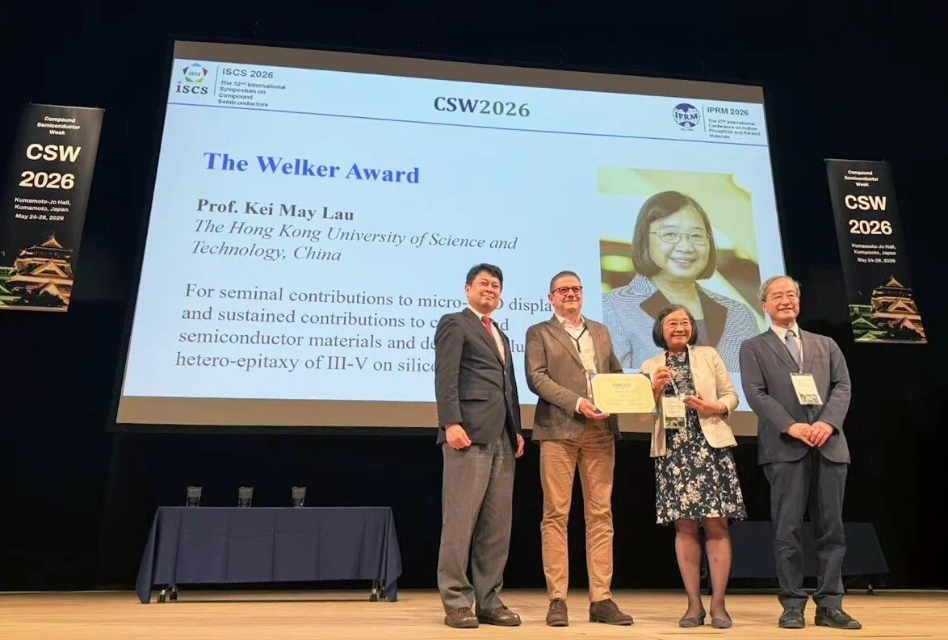
Raysolve is delighted to congratulate Professor Kei May Lau, Member of the U.S. National Academy of Engineering (NAE), Fellow of the Hong Kong Academy of Engineering Sciences (HKAES), Professor Emerita in the Department of Electronic and Computer Engineering, and Research Professor in the Academy of Interdisciplinary Studies at The Hong Kong University of Science and Technology (HKUST), on receiving the prestigious 2026 Heinrich Welker Award.
This remarkable achievement is particularly significant as Professor Lau becomes the first scientist to receive this distinguished honor based entirely on research breakthroughs achieved in Hong Kong.
Established in 1976, the Heinrich Welker Award recognizes scientists who have made outstanding and pioneering contributions to the research and application of III-V compound semiconductors. Widely regarded as one of the highest honors in the field, the award has been presented to many of the world's most distinguished researchers, including Nobel laureates and members of leading national academies of sciences and engineering.
Professor Lau's selection for this award reflects her exceptional contributions and global impact in compound semiconductor materials and devices, particularly her groundbreaking work in silicon-based III-V heteroepitaxy and Micro-LED display technologies.
Commenting on the award, Professor Lau said:
“I am deeply honored to receive this recognition. Throughout my career, I have followed the path paved by generations of scientists whom I have long admired. Since the 1960s, compound semiconductors have often been viewed as the ‘underdog sibling’ of silicon, and some have even joked that their promise would always remain in the future. Yet today, compound semiconductor devices are essential components of the technologies that connect our world, from fiber-optic communications to Wi-Fi. I chose to believe in that future, and together with my research team, I have enjoyed the journey of discovery and innovation. What is particularly gratifying is that the work we accomplished at HKUST has earned recognition from leaders across the international scientific community.”
For decades, Professor Lau has been dedicated to bridging the gap between fundamental research and industrial applications of III-V compound semiconductors. Her team at HKUST pioneered the monolithic integration of III-V semiconductor devices on industry-standard silicon substrates using metal-organic chemical vapor deposition (MOCVD). In 2008, the team successfully demonstrated high-mobility III-V transistors directly grown on silicon, laying an important foundation for next-generation optoelectronic and integrated circuit technologies.
More recently, Professor Lau's research team developed the Lateral Aspect Ratio Trapping (LART) technology, enabling efficient coupling with silicon waveguides and creating new opportunities for future communication technologies. In addition, her patented silicon-based monolithic full-color Micro-LED technology has been successfully commercialized, opening a new pathway for next-generation AR display systems. The technology not only advances the Micro-LED microdisplay industry but also provides a critical foundation for lightweight, high-performance AR smart glasses. These innovations have attracted significant interest and adoption from leading global technology companies and innovators.
Professor Lau is also a key member of Raysolve's founding team. Raysolve's continuous innovation and breakthroughs in monolithic full-color Micro-LED microdisplay technology are built upon the scientific achievements and technological foundations established through Professor Lau's decades of pioneering research. She continues to provide invaluable guidance on the company's technology development and strategic direction and remains one of the principal architects of Raysolve's innovation ecosystem.
Receiving the Heinrich Welker Award is not only a testament to Professor Lau's extraordinary academic achievements, but also highlights the growing importance of compound semiconductor and Micro-LED technologies in shaping the future of global innovation.
Raysolve extends its warmest congratulations to Professor Kei May Lau on this well-deserved recognition. Looking ahead, Raysolve remains committed to innovation-driven development and will continue advancing Micro-LED microdisplay technologies to help enable the next generation of AR glasses and intelligent wearable devices.
This remarkable achievement is particularly significant as Professor Lau becomes the first scientist to receive this distinguished honor based entirely on research breakthroughs achieved in Hong Kong.
Established in 1976, the Heinrich Welker Award recognizes scientists who have made outstanding and pioneering contributions to the research and application of III-V compound semiconductors. Widely regarded as one of the highest honors in the field, the award has been presented to many of the world's most distinguished researchers, including Nobel laureates and members of leading national academies of sciences and engineering.
Professor Lau's selection for this award reflects her exceptional contributions and global impact in compound semiconductor materials and devices, particularly her groundbreaking work in silicon-based III-V heteroepitaxy and Micro-LED display technologies.
Commenting on the award, Professor Lau said:
“I am deeply honored to receive this recognition. Throughout my career, I have followed the path paved by generations of scientists whom I have long admired. Since the 1960s, compound semiconductors have often been viewed as the ‘underdog sibling’ of silicon, and some have even joked that their promise would always remain in the future. Yet today, compound semiconductor devices are essential components of the technologies that connect our world, from fiber-optic communications to Wi-Fi. I chose to believe in that future, and together with my research team, I have enjoyed the journey of discovery and innovation. What is particularly gratifying is that the work we accomplished at HKUST has earned recognition from leaders across the international scientific community.”
For decades, Professor Lau has been dedicated to bridging the gap between fundamental research and industrial applications of III-V compound semiconductors. Her team at HKUST pioneered the monolithic integration of III-V semiconductor devices on industry-standard silicon substrates using metal-organic chemical vapor deposition (MOCVD). In 2008, the team successfully demonstrated high-mobility III-V transistors directly grown on silicon, laying an important foundation for next-generation optoelectronic and integrated circuit technologies.
More recently, Professor Lau's research team developed the Lateral Aspect Ratio Trapping (LART) technology, enabling efficient coupling with silicon waveguides and creating new opportunities for future communication technologies. In addition, her patented silicon-based monolithic full-color Micro-LED technology has been successfully commercialized, opening a new pathway for next-generation AR display systems. The technology not only advances the Micro-LED microdisplay industry but also provides a critical foundation for lightweight, high-performance AR smart glasses. These innovations have attracted significant interest and adoption from leading global technology companies and innovators.
Professor Lau is also a key member of Raysolve's founding team. Raysolve's continuous innovation and breakthroughs in monolithic full-color Micro-LED microdisplay technology are built upon the scientific achievements and technological foundations established through Professor Lau's decades of pioneering research. She continues to provide invaluable guidance on the company's technology development and strategic direction and remains one of the principal architects of Raysolve's innovation ecosystem.
Receiving the Heinrich Welker Award is not only a testament to Professor Lau's extraordinary academic achievements, but also highlights the growing importance of compound semiconductor and Micro-LED technologies in shaping the future of global innovation.
Raysolve extends its warmest congratulations to Professor Kei May Lau on this well-deserved recognition. Looking ahead, Raysolve remains committed to innovation-driven development and will continue advancing Micro-LED microdisplay technologies to help enable the next generation of AR glasses and intelligent wearable devices.


Next article
SID Display Week 2026 | Raysolve Showcases Full PowerMatch® 1 Series and Advanced AR Waveguide Prototypes
May 11, 2026